We have created a new tab on the website. Under this new tab, “Haiti Mission Trip Photo Album,” you will find lots of pictures we have taken in our recent mission trips to Haiti–for the year 2015 and 2016. Enjoy!!!


Hello friends: It is that time of the year again!
I am writing to you to solicit your assistance on behalf of underrepresented students and families in Haiti!
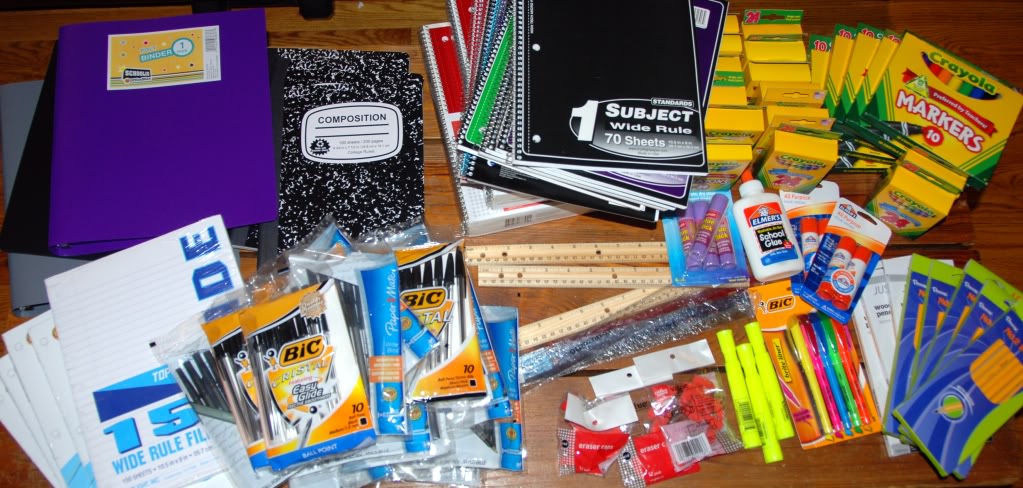
Hope for Today Outreach (HTO), a Christian faith-based and non-profit organization that serves and empowers underrepresented families, the poor, and the needy in Haiti, is seeking a way to provide 500 backpacks to underprivileged students and families in Port-Margot, Haiti, for the next academic school year, 2016-2017. Although school supplies are welcome, but our emphasis is on distributing backpacks this year.
HOW YOU CAN HELP US
Basically, there are two ways to RESPOND to this URGENT request:
1. You can buy a backpack and send it to us at the address listed below or you can provide any item on the list below:
Mailing Location
Hope for Today Outreach (HTO)
P.O. Box 7353
Port Saint Lucie, FL 34985
phone: 772-985-0696
email: customers@hopefortodayoutreach.org
2. You can make a donation by clicking on the support tab on Hope for Today Outreach website.
* Any contribution you make will change a student’s future and enhance his/her education in Haiti. The deadline to provide any of these items is August 12, 2016.
Thanks for your kindness and generosity!
Dr. Celucien Joseph (“Doctor Lou”)
President of Hope for Today Outreach
https://hopefortodayoutreach.org/

Hope for Today Outreach

“Remember the Poor”—Galatians 2:10
June 2016 Newsletter/Report
God’s glory Revealed in Port-Margot: June Mission Trip 2016
(To view the same document in PDF or Word format click on the appropriate preference)
In the past two weeks (June 4-20, 2016), my wife Katia and I (Dr. Joseph) went to Port-Margot for our second mission trip this year. The purpose of the mission trip was twofold (1) to teach a class on “Hermeneutics: How to Teach and Study the Bible”—to pastors and church leaders, and (2) to work on the logistics for the theological seminary (Hope for Today Theological Seminary, HTTS) we’re in the process of starting in Port-Margot. The June mission trip was full of expectations, surprises, and paradoxes; arguably, it was one of the most intensive activities Hope for Today Outreach has undertaken as a ministry in the past year and a half in Haiti. We fought many spiritual battles and were attacked by the enemy at every moment during the trip. Because the sovereign Lord has commissioned us at HTO to go and make disciples of all nations and peoples, especially in Port-Margot, Haiti, once again, he has proven himself to be faithful and our Rock, Shelter, and Safe and Hiding Place. Praise be to his glorious name!
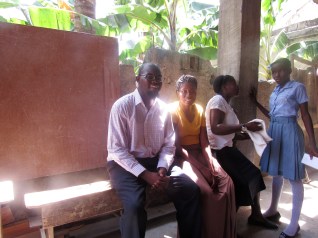

In the June 2016 newsletter and report, we would like provide an account of what God has done through us during our mission trip to Haiti.
Point of Beginning!
Katia and I landed in Port-au-Prince on Saturday, June 4; hence, our missionary journey began!
On Sunday, We visited a local church in Tabarre with Stanley Julme, my brother-in-law. It was wonderful to worship the Lord with this group of devoted Christians. I (Dr. Joseph) attended a conference in the next two days (Monday & Tuesday) in Port-au-Prince. On Wednesday, we headed for Jacmel to visit a good family of ours, Pierre St. Louis and his wife Lordphine, and to witness what the Lord is doing through their ministry there. Pierre and I attended Southwestern Baptist Theological Seminary in Fort Worth, Texas. While he was working on his Masters of Divinity, I was completing an advanced degree in New Testament Studies (Th.M.) at SWBTS. Two years ago, Pierre, his wife, and their three beautiful children relocated to Haiti to serve as permanent missionaries in Jacmel. Pierre is the founder of Future Generation International Missions. Pierre pastors a local church there, and he and his wife Lorphine are in charge of a girl orphanage in the beautiful city of Jacmel. It was wonderful to see and fellowship with them, hear from them about the vision God has given them for the people of Jacmel, and finally, to witness God’s amazing works through their collaboration and ministry. In our conversation with the St Louis, we were both encouraged and comforted by the fellowship of love, divine blessing, and friendship. We invite you to continue praying for the St Louis family, their ministry and personal needs in Jacmel.
God’s glorious majesty through the splendid nature and giant mountains in Jacmel was breathtaking. We are compelled to share with you some of these memorable pictures of various mountainous scenes and backgrounds:


We headed back to Port-au-Prince on the same day (In fact, it was at night). On Friday morning (June 11), we took the earliest bus to Cap-Haitien—“Okap,” as the Haitians say it–the 900 AM trip. After a six hour driving, we arrived safely in the historic city of Okap. On Saturday morning, we woke up very early (6:00 AM); we packed up our stuff and drove to Port-Margot, our missionary zone and ultimate destination. If the roads were good, we could have made it to Port-Margot in one hour; nonetheless, it took us two hours to get there.
Interestingly, on our way to Port-Margot, we stopped at a gas station to buy some gas. In Haiti, the driver does not put the fuel in the tank, a hired attendant is responsible to provide the service. Accidentally, the gas attendant put in the wrong fuel in the car: she filled up the tank with Diesel. The car wouldn’t start afterwards—as the driver and I (Dr. Joseph) attempted all the tricks to get it moving. We were not successful! We left the gas station around 3:26 PM; it was about 8:00 AM when we got there to put the gas. The mechanic had to pull out the gas tank and the gas filter so he could drain out the wrong fuel from the reservoir. He also had to clean the gas tank effectively. He and his team spent about 2 to 3 hours trying to lower down the tank. When they were through, they spent another hour or so to put it back the way it was before. Unfortunately, the car wouldn’t start after these gentlemen have done all these works. They decided to put the tank down one more time and checked to see what went wrong in the process. Then, they put it back in its original position. By the time they were done with the job, it was already 3:26 PM. Katia, the driver, and I were both exhausted after this long period of waiting and anticipation. It could have been worst; we could have lost the transmission. God was in control and leading our steps!
After the job was done, the young lady who has put the wrong fuel in the car has asked us to give her a ride home because she did not have the money to catch the bus. On our way to her house, she informed us that she was a Christian and that instead of dropping her at home, she asked to drop her at her church so she could attend choir rehearsal. It was close to 7:00 PM when we finally arrived in Port-Margot. Can you imagine both the tiredness and the joy of being on mission with God? That’s the paradox of being a missionary!
Preaching on Sunday (Sunday: June 12)
We arrived in Port-Margot on Saturday night; on the same day, Pastor Nicodeme Pierre-Louis (“Pastor Nico”), the lead pastor of our partner-church, l’Église Wesleyenne de Mont-Pisgah, has confirmed with me that I would be the preacher for the Sunday morning service. Knowing the routine in Haiti, before I left for Haiti, I was already prepared a sermon to preach on that Sunday. Therefore, I let the Spirit of God guide my thought-process and thinking, and used me to lift up Christ and edify the people of God through the ministry of preaching. I delivered the Word of God bearing the sermonic title “The Imperative of Proclaiming the Resurrection of Christ in Mission and Evangelism,” with a focus on 1 Corinthians 15: 1-5, and Romans 10: 9-17. Church attendance on that Sunday morning surpassed the usual number. Interestingly, immediately after my preaching, Pastor Nico has also asked if I could bring the evening message. I graciously accepted the invitation. In the night sermon, I continued with the same theme, with a particular focus on being a missionary church. Please continue praying for the people of God at the Église Mont-Pisgah for their needs—both spiritual and material—are great. God has placed this church as a light in the community.


Hermeneutics Class: How to Teach and Study the Bible (Monday: June 13)
Usually, HTO’s trainings for pastors and church leaders in Port Margot involve a large number of people—last December 2015, we provided training to about 400 ministers for a seminar on the book of Romans (Part I), and 300 people were in attendance in our March training 2016 (Part 2). For this special training on how to teach and study the Bible, which was held on Monday, only 96 church leaders attended, representing about 12 churches in the Region (Generally, in Haiti, it is good to always plan ahead of time; however, it does not mean things will go well as one has planned). Two days before the event, Pastor Nico has informed me that few people will attend the conference, as it was that time of the year that some of these pastors and ministers were administering final exams; some of them work as school teachers and administrators. By the way, 25 individuals who were in attendance signed up to attend Hope for Today Theological Seminary (HTTS). In our previous teaching seminar in March, about 27 individuals have signed up and demonstrated interest to receive a biblical-centered theological education. Glory be to God! With God’s grace, provision, and guidance, we anticipate to begin offering classes at the Certificate level in January 2017. We are currently negotiating with the owner to lease us the home for HTTS to find its home in the city Port-Margot!


Dr. Joseph: “Overall, it was one of the most joyful experiences I had the privilege to share with these engaging and enthusiastic men and women of God, as I attempted to teach them some fundamental principles on biblical hermeneutics. The Q & A moment was exhilarating and throught-provoking. Real Questions! Real Answers! I have learned a lot of important things about the local churches and ministries from my conversations with these individuals.”


What should one next do after teaching an exciting course on biblical hermeneutics?
Door-to-Door Evangelism in Terre Rouge (Tuesday: June 14)
The next step for the HTO team was for us to explore the evangelistic aspect of the mission trip. After Dr. Joseph has preached two powerful and instructive sermons on the art of evangelism and the intersection of Christian mission, evangelism, and the resurrection of Christ, the next inevitable step was to do some practice in the streets. Hence, a group of passionate Christians from Mont-Pisgah accompanied me, Katia, and Pastor Nico to Terre Rouge. We were divided in two separate teams or groups. Terre Rouge (“Red Land”) is a mountainous area and one of the most isolated and ungodly places in Corail, Port-Margot. It is one also of the largest communities in the Corail-Vigoureux area. Over 100 families live there in various “lakou,” compounds. In our last mission trips in December 2015, and March 2016, we attempted to visit there; I (Dr. Joseph) personally longed to visit Terre Rouge in order to share the good news of Christ and forge friendship with the people of Terre Rouge. We were prevented in both occasions. Only the great Lord knows the reason! Although, we couldn’t make it there in our March visit, in April this year, we were able to send off homecare items for 100 families. In addition, in the September 2015 trip, we supplied backpacks and school supplies to several disadvantaged students and families of Terre Rouge. We pray these deeds of kindness and compassion would increase.


The partner-church (Mont-Pisgah) has appointed a community leader and an evangelistic team to minister to the people of Terre Rouge. According to Pastor Nico and the church leader-in-charge of that Region, no one in this community has a relationship with Christ. The Church has been involved in evangelistic outreach in Terre Rouge for a long time, and such a time as this, God has called us HTO to partner with the church to continue reaching out to these individuals and bring the light of the Gospel of Christ to them.

Together, we participated in street evangelism in various neighborhoods and knocked on 52 homes in Terre Rouge. We prayed in every home we visited and stopped; we talked to the people, listened to their personal needs, and established new friendship with them. When presenting the Gospel to the people of Terre Rouge, the common response from them was that at the moment, they were not ready to accept the Gospel and make peace with God through Christ. They also stated that we cannot go to church because we do not have any clothes. Please continue to pray for the people in Terre Rouge so God would soften their hearts toward repentance and salvific faith in Christ. Also, pray that God would supply their material needs.

In the midst of the obstacles and difficulties we encountered in and along the way to Port-Margot, God’s faithfulness was constant and his care and love for the people of Port-Margot and toward us was uplifting and transformative. God’s glory was indeed revealed in our encounters, in the various lives he had touched through us and the activities we undertook for the sake of his name, renown, and glory.
Prayer Requests and Needs
Please consider praying for the following needs of Hope for Today Outreach
In Christ,
Rev. Dr. Celucien L. Joseph
President
Hope for Today Outreach (HTO)
P.O. Box 7353
Port Saint Lucie, FL 34985
772-985-0696
customers@hopefortodayoutreach.org
Entrusting/Trusting God in All Things

Peter 2:23 (NIV)
“When they hurled their insults at him, he did not retaliate; when he suffered, he made no threats. Instead, he entrusted himself to him who judges justly.”
What does it mean to trust God?
To trust God means that we believe in the promises of God in all circumstances, even in those where the evidence seems to be contrary.
How does trusting God bring confidence? Trusting God brings confidence in the Christian life because it allows us to see God’s true character. It also causes us to realize the greatness of his love for us. Very often, God fails to do things for us because we do not permit him to do so. We want to plan for ourselves. We want things to be done in the way that seems best to our limited wisdom.
Furthermore, trusting in God means total obedience. It means working and walking with God to produce godly results. As Christians, we cannot sit down and fold our hands and expect things to work themselves out. Rather, we need to pray unceasingly. We must be obedient workers, because our attempts to trust him who is able to accomplish all things according to his will and plan for our lives will amount to nothing if we are not willing to obey.
There is a different between trusting God and entrusting in God. Entrust implies committing with trust and confidence. In the verse mentioned above, the Apostle Peter tells us that when Jesus experienced suffering, He entrusted Himself to God. Entrusting in God is something we do because we believe. Entrusting is more than just believing; entrust is an active trust, not passive. It requires a change in one’s behavior not in one’s thinking. So for us Christians, “entrust” in God must follow our “trust” in God; to put simply, trust in God is the first step, and entrust in God in the next step in our faith.
For Christians, trusting in God means believing in him, having confidence in him, and obeying him. When you entrust yourself to God, you will submit, surrender, and yield yourself to him so that what you believe God can and will do will happen. To trust God in all things is to live actively a victorious life and a life of discipleship.
Katia
Dear HTO Friends and Supporters,
In December 2015, Hope for Today Outreach sent a team (Dr. Celucien Joseph and his wife Katia Joseph, and other partners in Haiti) to the rural area of Corail, Port Margot (Haiti). As we walked through the neighborhoods, handing out small donations to families, we were have witnessed God’s love, grace, and mercy toward the people of Port-Margot. The people were very grateful and thankful for what they received from us. Their words of appreciation made us feel so proud of we have achieved so far at Hope for Today Outreach (HTO). We witnessed their poverty and suffering, and we realized how much we needed to add to our donations food such as rice, beans, and non-perishable food. And this is the reason why we are writing to you now, to request your help, with either a donation of funds to buy the food for the people or a donation of food (rice, beans, and non-perishable food) to provide for 500 underprivileged and poor families in Port-Margot.
Hope for Today Outreach puts great emphasis on feeding the hungry and the poor, as we believe the biblical imperative to always “remember the poor” (Galatians 2:10). I’m sure you know of how important it is to care for the less fortunate… They are our brothers and sisters after all. Obviously, we won’t be able to accomplish this task without the assistance of partners and supporters like you; hence, we beseech you to help us by sponsoring HOP or by donating the items needed for our June mission trip to Port-Margot, Haiti.
By sponsoring and helping feeding the poor of Corail, Port Margot, you will be reaching out to many undeserved families, alleviating hunger and poverty in the Region, and making a tremendous difference in the lives of children, young people, and families in such a big way!
For my Christian friends (being a follower of Christ), I’m sure you will understand the importance of giving to the poor and care for the needy; it is a way to spread the good news and love of Christ, and this is what this ministry’s main goal! We want to reach out to the people of Port Margot and help them to know the Lord in a personal way, yet through our act of kindness and compassion. Also, by helping us feeding the people of Corail, HTO will be providing a huge service to all the families.
If you would like to sponsor or provide assistance toward this coming mission trip in June, please contact me, Katia Joseph via the telephone (772-985-0696), or via email at customers@hopefortodayoutreach.org. If you would like to send the donations (financial support, rice, beans, and non-perishable food) to us, please send it to the address listed below:
Hope for Today Outreach (HTO)
P.O. Box 7353
Port Saint Lucie, FL 34985
To make a donation through our online service, please click on the PayPal button below:

HTO is sending a mission team to Port-Margot in June 4, 2016. If you are sending any of these items listed below, please do so by Monday, May 9, 2014 so we the items can be shipped to Haiti on a timely manner before we arrive.
We thank you for the time you have taken to read this letter.
Blessings in Christ,
Katia
It brings great joy when other people recognize your work and contributions to society, hoping that they’re potentially transforming people’s lives and enhancing human relations. We just found out today that the Haitian magazine named Marchons-Unis has published an article about Dr. Celucien L. Joseph and the work of Hope for Today Outreach in Haiti. They even have Dr. Joseph on the front cover of the magazine for the October-December 2015 issue.
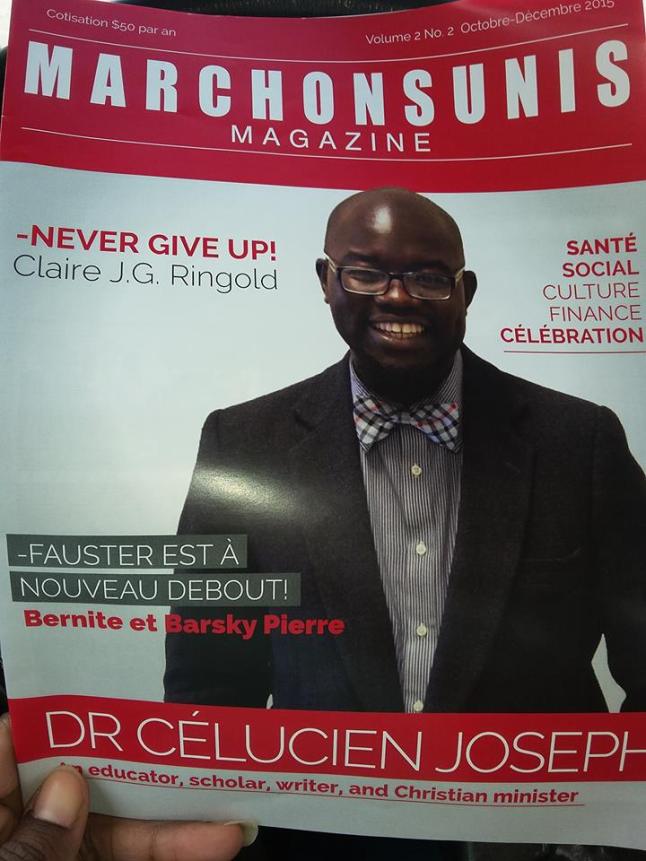
*Dr Joseph writes: ” I’m humble by this great act of public recognition. Let’s continue to serve, give, love, and collaborate together to alleviate human suffering and poverty in Haiti and contribute to sustaining and long-lasting development to the glory of God. Marchons-Unis!”
We would like to announce that Hope for Today Outreach’s phone number has changed. The new number is 772-985-0696.
Blessings,
HTO Partner in ministry
20 Simple Truths Everybody Should Learn about God, Life, and People
by Dr. Celucien L. Joseph

*This post was originally published in Dr. Joseph’s personal website.
 Hope For Today Outreach ("REMEMBER THE POOR"-- GALATIANS 2 :10)
You must be logged in to post a comment.